
Introduction to One Piece Filler Episodes
One Piece is one of the longest-running anime series in history, spanning over a thousand episodes and continuing to grow. With such a massive episode count, it’s natural that the anime includes filler content—episodes or arcs that are not directly adapted from the manga.
For new viewers and even long-time fans, understanding which episodes are canon and which are filler can make the viewing experience more efficient and enjoyable. This is where a complete <a href=”#”>one piece filler list</a> becomes incredibly useful.
What Is Filler in Anime?
Filler episodes are anime-exclusive content created to give the manga time to progress ahead of the anime adaptation. Since One Piece follows its original manga closely, filler arcs are inserted occasionally to avoid catching up too quickly.
These episodes may:
- Expand on side stories
- Introduce temporary characters
- Offer comedic or light-hearted adventures
- Provide breaks between major story arcs
While filler is often seen as optional, some arcs are entertaining and worth watching.
Canon vs Filler in One Piece
Understanding the difference between canon and filler is essential:
- Canon Episodes: Directly adapted from Eiichiro Oda’s manga
- Filler Episodes: Created by the anime studio and not part of the original storyline
- Mixed Episodes: Contain both canon and filler elements
One Piece is known for having relatively low filler compared to other long anime, which makes it easier to follow the main story.
Complete One Piece Filler Arcs
Below is a breakdown of the major filler arcs in One Piece:
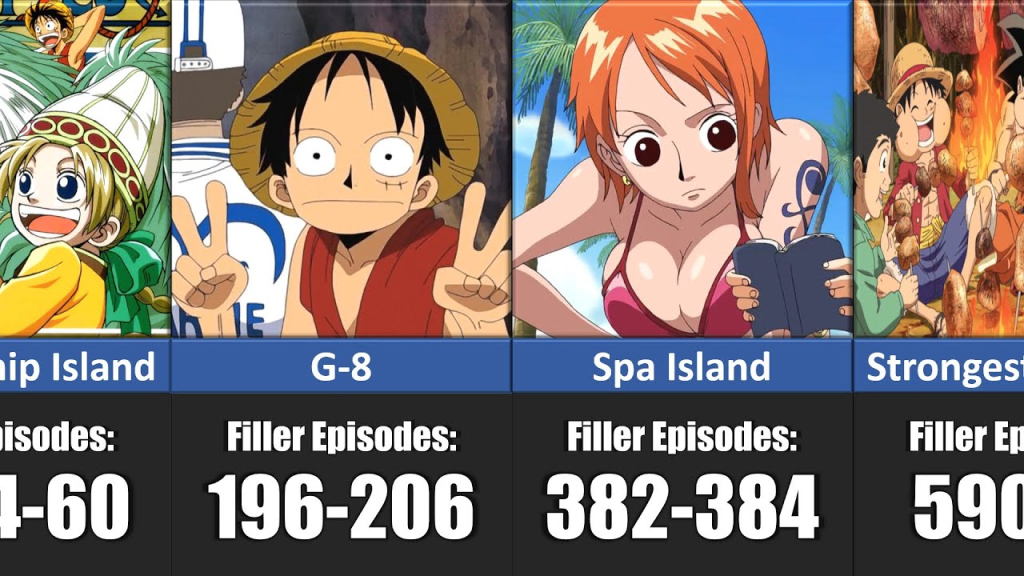
Warship Island Arc (Episodes 54–61)
This is the first filler arc in the series. It introduces a young girl named Apis and focuses on a mystical dragon storyline.
Post-Alabasta Arc (Episodes 131–135)
A short arc that dives into individual backstories of the Straw Hat crew members after the Alabasta saga.
Goat Island Arc (Episodes 136–138)
A light-hearted adventure featuring an old man and a group of goats on a remote island.
Ruluka Island Arc (Episodes 139–143)
This arc involves a mysterious island with a dictator and strange time-related phenomena.
G-8 Arc (Episodes 196–206)
One of the most highly praised filler arcs. It follows the Straw Hats infiltrating a Marine base after falling from Skypiea.
Ocean’s Dream Arc (Episodes 220–224)
A unique storyline where the crew loses their memories and must rediscover their bonds.
Foxy’s Return Arc (Episodes 225–226)
A continuation of the Foxy Pirates storyline with comedic elements.
Ice Hunter Arc (Episodes 326–335)
The crew faces bounty hunters who use ice-based strategies to capture pirates.
Spa Island Arc (Episodes 382–384)
A short comedic arc set in a luxurious spa resort.
Little East Blue Arc (Episodes 426–429)
A special arc that ties into the One Piece Film: Strong World movie.
Z’s Ambition Arc (Episodes 575–578)
A filler arc connected to One Piece Film: Z.
Caesar Retrieval Arc (Episodes 626–628)
A short filler storyline following the Punk Hazard arc.
Silver Mine Arc (Episodes 747–750)
This arc ties into One Piece Film: Gold and features a dangerous mining island.
Marine Rookie Arc (Episodes 780–782)
Focuses on the Straw Hats disguising themselves inside a Marine base.
Cidre Guild Arc (Episodes 895–896)
A promotional arc linked to One Piece: Stampede.
Uta’s Past Arc (Episodes 1029–1030)
A recent filler arc that connects to One Piece Film: Red.
Which Fillers Should You Watch?
Not all filler arcs are created equal. Some are skippable, while others are highly recommended.
Must-Watch Filler Arcs
- G-8 Arc: Strong storytelling and humor
- Post-Alabasta Arc: Adds emotional depth to characters
- Uta’s Past Arc: Provides context for recent movie content
Skippable Filler Arcs
- Goat Island Arc
- Ruluka Island Arc
- Spa Island Arc
These arcs are generally less impactful and can be skipped if you want to focus on the main story.
Mixed Canon/Filler Episodes
In addition to full filler arcs, One Piece includes episodes that blend canon and filler content. These episodes may include:
- Extended fight scenes
- Added dialogue or flashbacks
- Slower pacing to match manga progress
While technically canon, these episodes can feel slower but still contribute to the overall narrative.
How Filler Affects the Viewing Experience
Filler episodes can influence how you experience One Piece in several ways:
Advantages
- Provides additional content and world-building
- Offers comedic and relaxing moments
- Explores side characters
Disadvantages
- Slows down pacing
- May feel disconnected from the main plot
- Can reduce tension between major arcs
Ultimately, whether to watch filler depends on your viewing preferences.
Tips for Watching One Piece Efficiently
If you want to enjoy One Piece without unnecessary delays, consider these tips:
- Use a filler guide to skip non-essential episodes
- Watch recommended filler arcs for extra enjoyment
- Take breaks between long arcs to avoid burnout
- Mix canon episodes with occasional filler for balance
This approach helps you stay engaged while still experiencing the richness of the series.
Why One Piece Has Less Filler Than Other Anime
Compared to other long-running anime like Naruto or Bleach, One Piece has a lower percentage of filler episodes. This is because:
- The anime often stretches canon scenes instead of adding filler arcs
- The pacing is adjusted to stay behind the manga
- The production focuses on maintaining story consistency
This makes One Piece more appealing for viewers who prefer a continuous storyline.
Conclusion
A complete understanding of the One Piece filler list can greatly improve your viewing experience. Whether you choose to skip filler entirely or enjoy selected arcs, knowing what to expect helps you navigate the series more effectively.
With its incredible story, unforgettable characters, and vast world, One Piece remains a legendary anime. By following a structured viewing approach, you can fully immerse yourself in the adventure without unnecessary interruptions.